
Is Finishing Your Basement Actually Worth the Money?
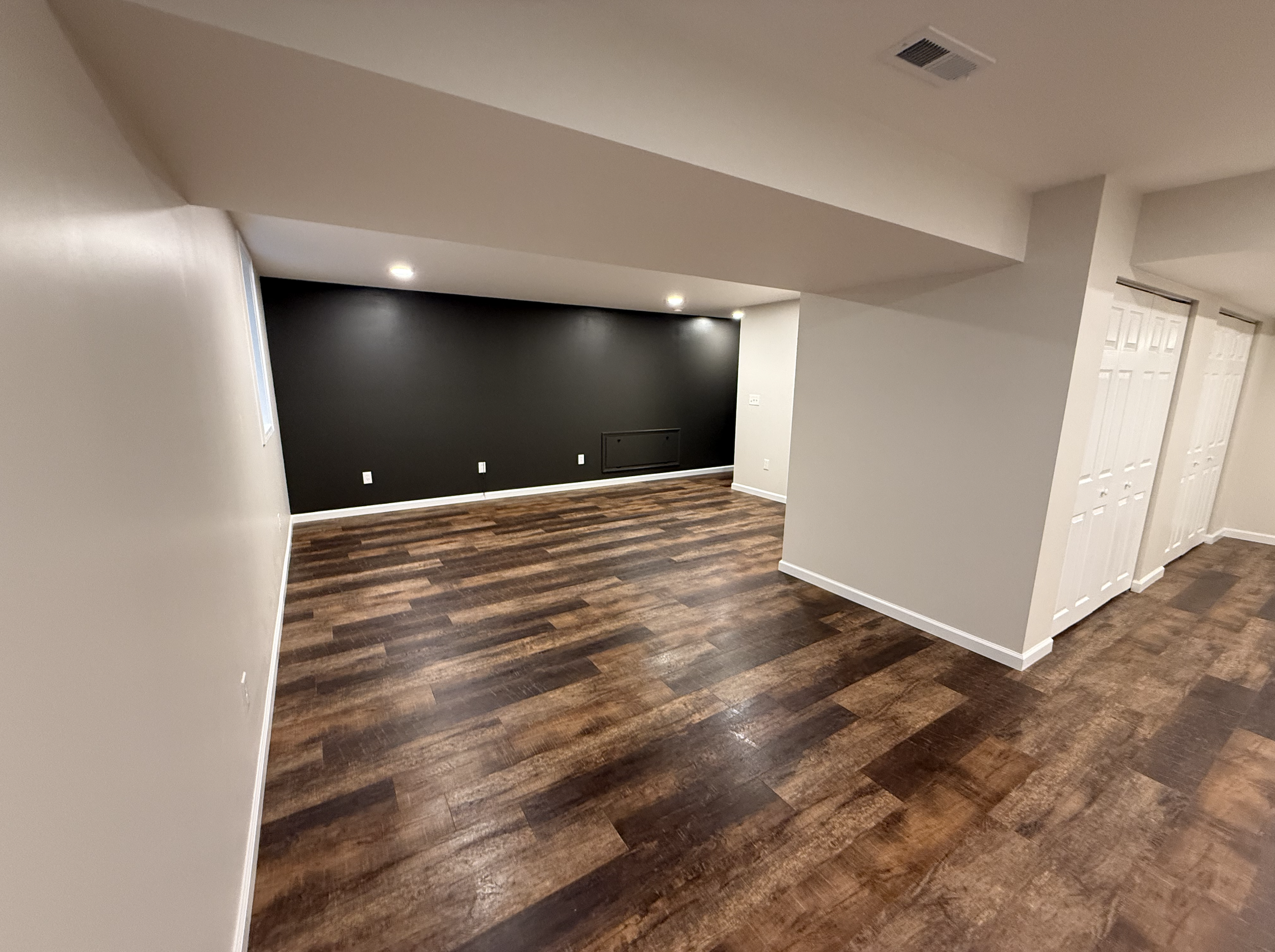
Finishing a basement rarely returns every dollar at resale, and it is still one of the smartest projects most homeowners in the western suburbs can do.
Those two things are both true, and the reason is that a basement is the only place you can add real living space for roughly half of what building new square footage costs.
If you are weighing a basement remodel against other projects, here is the honest math and the part of it that surprises people.
The number that matters: cost per square foot
Finishing an existing basement in this market generally runs about $50 to $90 per square foot for a straightforward layout, and higher if you are adding a bathroom, cutting in an egress window, or dealing with moisture remediation first.
Building a new addition, by contrast, typically runs $200 to $400 per square foot, because you are paying for a foundation, framing, a roof, siding, windows, and a full mechanical extension.
So a 900 square foot basement finish at $70 per foot is about $63,000 for the same amount of usable room that would cost well north of $180,000 to build onto the back of the house. That gap is the entire argument, and it does not depend on any resale assumption at all.
Why the appraisal will not credit it the way you expect
Here is what catches homeowners off guard. Finished basement space almost never counts toward your home's above-grade square footage on an appraisal.
Appraisers separate gross living area, which is the above-grade finished space, from below-grade finished space, and they value the below-grade portion separately at a meaningful discount. So a 2,000 square foot house with a 900 square foot finished basement does not become a 2,900 square foot house on paper. It stays a 2,000 square foot house with a finished basement, and the basement contributes as an adjustment rather than as square footage.
That is not a reason to skip it. It is a reason to stop expecting your appraisal to jump by the cost of the project. Cost-versus-value surveys have generally put basement finishing somewhere in the 60 to 75 percent recouped range in recent years, and it moves with the market, so treat any specific figure as a rough guide rather than a promise.
The three things that actually drive the return
Not all finished basements are valued alike, and the differences are predictable.
A full bathroom. This is the biggest single lever. A finished basement without a bathroom is a rec room. With one, it becomes space a guest, a teenager, or an in-law can actually use, and buyers price it accordingly. If your slab or existing rough-in allows a gravity drain, this is the easiest yes in the project.
Legal egress. A basement room without a code-compliant egress window or door cannot be marketed as a bedroom, and a bedroom is worth considerably more on a listing than a den. Cutting an egress window and building the well is a real expense, often several thousand dollars, and it is the difference between four bedrooms and three on the listing sheet.
Permitted work. Finished space that was permitted and inspected holds up at closing. Unpermitted finished space invites questions from the buyer's agent, the appraiser, and sometimes the lender, at the worst possible moment.
Everything else, the flooring choice, the bar, the built-ins, is about how much you enjoy it, not about the appraisal.
When the math clearly says do it
You need the room and you are staying. This is most people, and it is the strongest case. You get the space for a third of what an addition costs, you use it for ten years, and whatever you recover at sale is a bonus rather than the point.
Your lot cannot take an addition. Plenty of properties in Coraopolis, Sewickley, and Robinson have setbacks, slopes, or septic locations that make building out difficult or expensive. If the only direction available is down, the comparison is not basement versus addition. It is basement versus nothing.
You have a dry, tall, walkout basement. A daylight or walkout basement with decent ceiling height finishes better, feels less like a basement, and is valued more generously than a dark low one. If you have one, you are starting from the best possible position.
The bathroom rough-in is already there. A previous owner who roughed in a basement bath handed you a few thousand dollars. Use it.
When to think harder about it
The basement takes on water. Fix the cause first, and price that honestly, because finishing over a moisture problem destroys the work and the money. Often the cause is downspouts and grading rather than the foundation itself, which is cheap. Sometimes it is interior drain tile and a sump, which is not.
You have under about 6 feet 8 of clear height. You can finish it, and it will read as a low room no matter how well it is done. That affects both how much you use it and how a buyer sees it.
You are selling in under a year. You will very likely not recover the cost on a fast turnaround, and you will have lived through a construction project for someone else's benefit. Paint, lighting, and a clean, dry, well-organized unfinished basement is the better play before a listing.
You are considering a bedroom without egress. If the whole reason for the project is another bedroom, price the egress window before you commit. Without it, you are not getting the thing you are paying for.
The part nobody puts in a spreadsheet
Most of our basement customers do not talk about resale at all when we come back. They talk about the kids being downstairs with their friends instead of somewhere else, or the gym they actually use because it is fifteen steps away, or the fact that their parents can stay for a week now.
That is real value, it just does not appraise. If you have a dry basement, the ceiling height, and a family that needs a room, the return question is less important than it feels while you are deciding.
For a full cost breakdown see our guide to what it costs to finish a basement in Pittsburgh, and if you have already decided and are working on the layout, we covered that in finished basement ideas for Pittsburgh homes.
Frequently asked questions
Does a finished basement add value to a home?
Yes, but not dollar for dollar and not as above-grade square footage. Appraisers value finished below-grade space separately and at a discount. Cost-versus-value surveys have generally shown basement finishing recouping somewhere in the 60 to 75 percent range, and it varies with the local market.
Does a finished basement count as square footage?
Not toward gross living area, which is the above-grade figure used on appraisals and most listings. It is reported separately as finished below-grade space.
What adds the most value in a basement finish?
A full bathroom, then a code-compliant egress window if you want a bedroom, then having the work permitted and inspected. Those three affect the appraisal and the listing far more than finish selections do.
How much does it cost to finish a basement per square foot?
Roughly $50 to $90 per square foot in the Pittsburgh area for a standard finish. Adding a bathroom, an egress window, or moisture remediation pushes it up from there.
Is it cheaper to finish a basement or build an addition?
Finishing a basement is dramatically cheaper, usually $50 to $90 per square foot against $200 to $400 for new construction, because the foundation, walls, and roof already exist.
Want a real number for your basement?
Averages are a starting point, not a quote. Request your quote and we will look at your ceiling height, your drainage, your egress options and whether a bathroom is practical, then give you an itemized proposal you can actually plan around. Our own crew does the work, on time and on budget.
